
You check the mailbox, and there it is, the windowed envelope with the IRS return address. You open it hoping for a routine notice, but instead you find a balance due that dwarfs what you expected. Late-filing and late-payment penalties have swollen your debt by 25% or more. If you live in Los Angeles or the surrounding counties, that scene is playing out more often than ever, and it is understandable to feel overwhelmed.
The IRS recently announced something that sounds like welcome news for people in exactly this position: automatic penalty relief. It genuinely can help. What matters most, however, is understanding exactly what it does and does not cover, so it does not unintentionally distract you from the larger settlement strategy that can truly resolve your tax debt.
This article walks through the full picture, not just the piece the IRS automates. As a firm led by a CPA and Certified Tax Resolution Specialist, our role is to make sure you understand both what this relief accomplishes and what still requires attention.
What the New IRS Penalty Relief Really Means for Your Case
For the first time in the penalty program’s 25-year history, the IRS is moving to waive certain penalties automatically for taxpayers with a clean recent record. No phone call, no form, no request. The relief is applied during processing and confirmed by mail.
For someone facing a stressful notice, that is genuinely encouraging news. A single failure-to-file or failure-to-pay penalty being waived can meaningfully reduce what you owe.
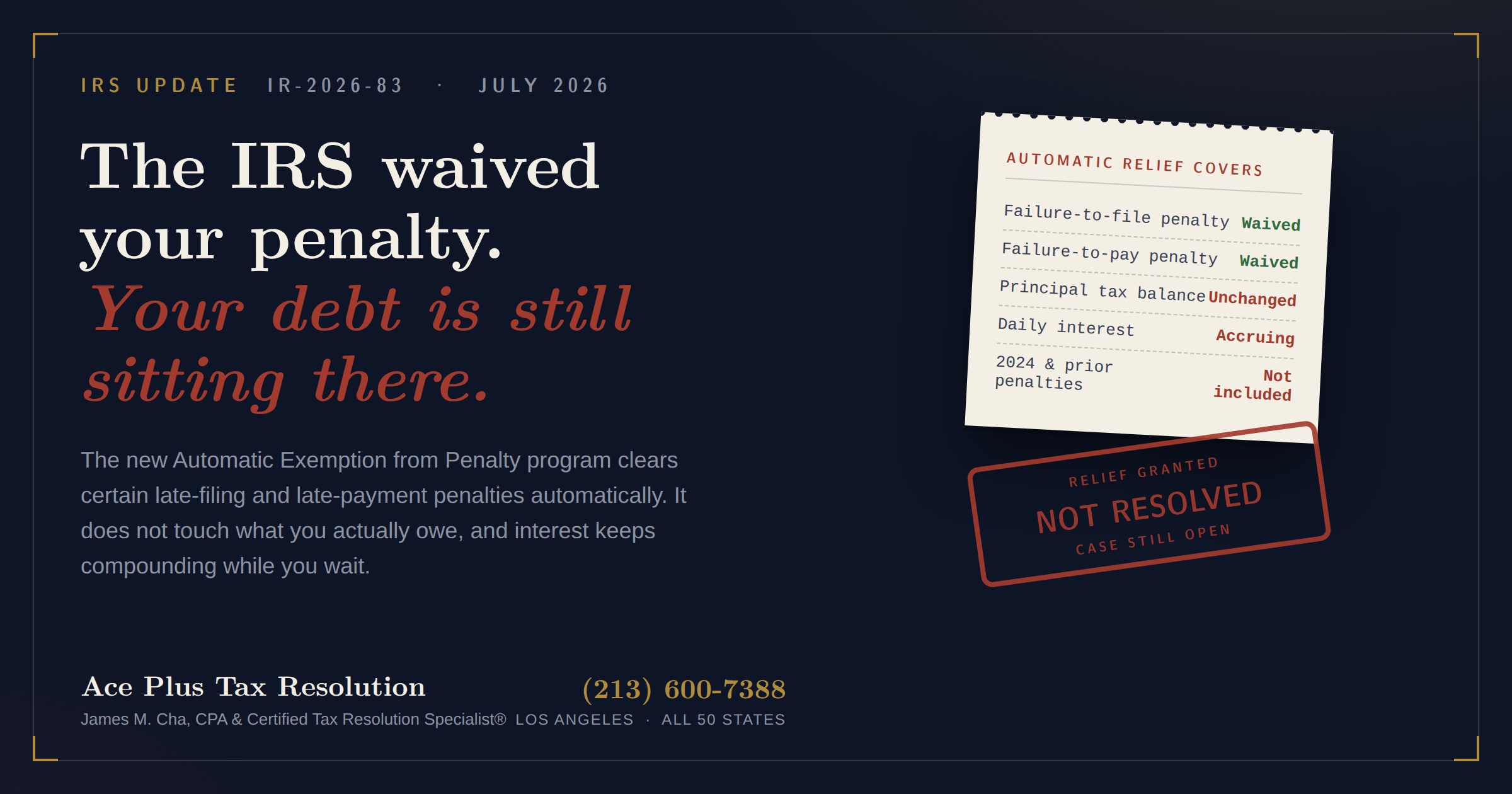
Here is the important nuance: that relief addresses only one part of the picture. It can be easy to feel like the matter is fully handled and set the notice aside. Meanwhile, the larger issue, the underlying tax balance plus interest that continues to accrue, remains untouched. Automated penalty relief does not eliminate your debt. It does not stop interest. And it does not address unfiled returns, prior-year penalties, or an audit.
Understanding the whole picture, not just the encouraging part, is what helps protect your long-term financial position.
What Is Automatic Penalty Relief (and What It Isn’t)?
The new policy is called the Automatic Exemption from Penalty (AEP) program, and it is intended to replace the long-standing First-Time Abatement (FTA) process. According to reports citing IRS announcement IR-2026-83, the IRS has outlined plans for AEP to automatically skip assessing certain penalties for taxpayers who filed and paid on time in the prior three years or the prior 12 consecutive quarters for quarterly filers.
National Taxpayer Advocate Erin Collins had previously signaled this shift. At an AICPA tax conference, she indicated that the IRS intended to begin applying first-time abatement automatically for qualifying taxpayers with no action required on their part. Collins has described the change as a significant taxpayer benefit, since relief would no longer depend on your income, your ability to reach the IRS by phone, or knowing to ask, per the Taxpayer Advocate Service [3].
AEP is intended to cover failure-to-file, failure-to-pay, and failure-to-deposit penalties, and, according to current announcements, is expected to fully replace FTA for returns with original due dates on or after January 1, 2027. As with any newly announced program, taxpayers should confirm current implementation details directly with the IRS or a qualified professional.
Here is what this relief is not:
- It is not tax debt forgiveness. Your principal balance stays exactly where it was.
- It does not stop interest. Interest continues to accrue on the unpaid tax, and it compounds daily.
- It does not reach prior years. For penalties on tax year 2024 and earlier, you must still request abatement manually, by phone, in writing, or with Form 843.
- It does not resolve complex problems. Unfiled returns, audits, liens, levies, and large balances all fall outside the scope of automatic relief.
For official context on how penalty relief works and how interest is adjusted when penalties are reduced, see the IRS penalty relief page [4]. This is not the first time the agency has automated relief either. It previously waived failure-to-pay penalties on assessed taxes under $100,000 for 2020 and 2021 returns during the pandemic pause, as described on IRS.gov [5].
Why a Small Penalty Break Should Not Delay a Full Resolution Strategy
The key is not to treat automatic relief as the finish line. It is best understood as one helpful step, not a complete solution.
Consider the Collection Statute Expiration Date (CSED), the ten-year window the IRS generally has to collect an assessed tax. Timing matters considerably in tax resolution. Every option you might pursue, from a settlement to a partial-payment arrangement, is shaped by how much of that ten years remains and how your finances look right now. When you receive an automatic penalty waiver and feel some relief, it is important not to delay further action. Interest continues to grow, and your circumstances may change in ways that make a favorable outcome more difficult to reach later.
Enforcement activity has also become more efficient. The IRS is expanding automated enforcement, using AI-driven systems to flag returns and issue liens, garnishments, and levies more quickly than in the past. While a penalty waiver may bring welcome relief, it is wise to address the full picture before collection activity advances.
It is completely natural to feel encouraged when a penalty is removed. As professionals, we also want to highlight an important distinction: automated relief is limited in scope, while automated collection continues to move forward. Acting early helps preserve your options.
Full Tax Resolution: The Solutions That Truly Solve Your Debt Problem
Penalty abatement is a helpful, narrow fix. Comprehensive tax resolution is a lasting solution. One reduces a fee. The other addresses the debt itself, works to stop enforcement, and supports genuine peace of mind.
A qualified specialist reviews your entire financial picture and matches you to the right strategy. Below are the tools that go far beyond automatic penalty relief. You can review the full range on our services page, and if you owe back taxes in Los Angeles, these are the paths we use to help clients resolve tax debt in Los Angeles.
Offer in Compromise (OIC)
An Offer in Compromise lets you settle your tax debt for less than the full amount owed. The IRS may accept it when paying in full is not realistic given your income, expenses, and asset equity. It is the option people mean when they talk about “settling” with the IRS, and, depending on your circumstances, it may help reduce collection pressure and support a more manageable financial future. California has its own version through the Franchise Tax Board, so state and federal strategy often move together. This is one of the tools we use most often to pursue tax debt relief in Los Angeles, but eligibility is technical and the application must be built carefully.
Partial Payment Installment Agreement
A Partial Payment Installment Agreement (PPIA) lets you make monthly payments based on what you can genuinely afford, with the possibility that some of the balance may remain uncollected before the CSED runs out. It suits taxpayers who cannot pay the full debt over time but can handle a modest monthly amount. Structuring it correctly requires an honest, well-documented look at your finances.
Currently Not Collectible (CNC) Status
If paying anything toward your tax debt would leave you unable to cover basic living expenses, the IRS may place your account in Currently Not Collectible status. Collection activity generally pauses while your account is in CNC. It does not erase the debt or stop interest, but it can stop levies and garnishments and provide room to plan.
When the IRS threatens to seize wages, bank funds, or property, timely action matters. We help clients pursue release of wage and bank levies and address liens through discharge, subordination, or release. If a CP504 or Letter 11 has arrived in your mailbox, act promptly. You also have specific rights in California as a taxpayer facing collection action.
When the IRS threatens to seize wages, bank funds, or property, timely action matters. We help clients pursue release of wage and bank levies and address liens through discharge, subordination, or release. If a CP504 or Letter 11 has arrived in your mailbox, read our breakdown of what to do when you receive a CP504 or Letter 11, then act promptly. You also have specific rights in California, which we cover in our guide to stopping IRS collections in California.
Why You Need a Local Los Angeles Tax Resolution Specialist
You can try to handle the IRS on your own, and for a simple, current-year penalty, the automatic relief may be sufficient. When there is a substantial balance, prior-year penalties, unfiled returns, or the threat of enforcement, professional representation can make a meaningful difference. Searching for a Tax Resolution Specialist near me is a sound instinct, and who you choose matters.
Ace Plus Tax Resolution was founded by James M. Cha, a CPA and Certified Tax Resolution Specialist® with over 30 years of experience resolving IRS and state tax problems. That combination matters. A CPA understands the numbers behind your case, and a Certified Tax Resolution Specialist knows how to negotiate directly with tax authorities. You can read more about James and our approach on our about page.
Los Angeles taxpayers face two agencies, not one: the IRS on the federal side and the California Franchise Tax Board on the state side. A local firm that handles both is a real advantage over a national call center where your file gets passed between strangers. We are based in Los Angeles and licensed to represent taxpayers in all 50 states, so you get local knowledge and full reach. That is what genuine Los Angeles tax debt assistance looks like.
Be thoughtful about who you trust. The Federal Trade Commission warns that many tax-relief companies charge large upfront fees or recurring “maintenance fees,” often fail to actually settle debts, and it encourages consumers to first consider a payment plan directly with the IRS, a Low Income Taxpayer Clinic, or the Taxpayer Advocate Service. Red flags to watch for:
- Guaranteed outcomes or promises to erase your debt before reviewing your finances.
- Large fees demanded upfront, or vague, growing “maintenance” charges.
- No named, credentialed professional actually working your case.
A trustworthy firm is transparent about credentials, honest about what is achievable, and clear about fees. You can see how we frame that commitment on our main tax resolution page. We never guarantee a specific IRS result. We do bring proven strategies, deep experience, and our best effort to every case. If you are comparing options for local tax relief or searching for tax help near me, look for a licensed, credentialed professional with a demonstrated track record.
Frequently Asked Questions
What is IRS first-time penalty abatement, and who qualifies? First-time abatement removes certain penalties for taxpayers who have a clean compliance history, meaning they filed and paid on time in the prior three years (or the prior 12 quarters for quarterly filers). It applies to failure-to-file, failure-to-pay, and failure-to-deposit penalties. The IRS has announced plans to transition this into the automatic AEP program.
Is the IRS now automatically waiving penalties? In part, yes. According to reports, the IRS intends to apply penalty relief automatically to qualifying taxpayers with no action needed. The new AEP program is expected to fully replace manual first-time abatement for returns due on or after January 1, 2027. It does not apply to prior-year penalties, which you must still request. We recommend confirming current program status with the IRS or a qualified professional.
Does getting a penalty removed help my chances for an Offer in Compromise? Removing a penalty lowers your balance, which is helpful. It is only one piece, though. An Offer in Compromise is decided by your full financial picture and the collection timeline, not by whether a single penalty was waived. Relying solely on the automatic waiver and delaying further action can affect the CSED timeline and your settlement position. A coordinated strategy helps protect your options.
What’s the difference between penalty abatement and total tax resolution? Penalty abatement reduces a fee. Total tax resolution addresses the underlying debt, works to stop or prevent enforcement, brings you into compliance, and puts a lasting plan in place through options like an Offer in Compromise, an installment agreement, or Currently Not Collectible status.
Which penalties can be abated? The common ones are failure-to-file, failure-to-pay, and failure-to-deposit penalties. Interest generally is not abated on its own, though it is adjusted when the penalty it relates to is reduced or removed, as the IRS penalty relief page explains [4]. Some penalties tied to accuracy or fraud follow different rules.
How do I know if a tax resolution company is legitimate? Look for a named, credentialed professional such as a CPA, enrolled agent, or tax attorney working your case. Be cautious of guaranteed results and large upfront or open-ended fees, which the FTC flags as warning signs. A legitimate firm is transparent about who handles your file, honest about likely outcomes, and clear about cost.
Take Control of Your Tax Situation Today
Automatic penalty relief is real, and for a clean-history taxpayer with one recent slip, it can genuinely help. It is important not to let it delay a broader resolution plan. It does not forgive your debt, stop your interest, or shield you from collection, and every month that passes, interest continues to grow while the IRS’s automated systems keep operating.
A resolution that brings lasting peace of mind takes a proactive, expert-led strategy built around your full financial picture. You do not have to face the IRS alone. Ace Plus Tax Resolution brings a CPA and Certified Tax Resolution Specialist® with over 30 years of experience to your case right here in Los Angeles.
Schedule a confidential consultation today to explore your options. Call (213) 600-7388.